GST Registration Guide AY 2025-26 & FY 2026-27
Introduction
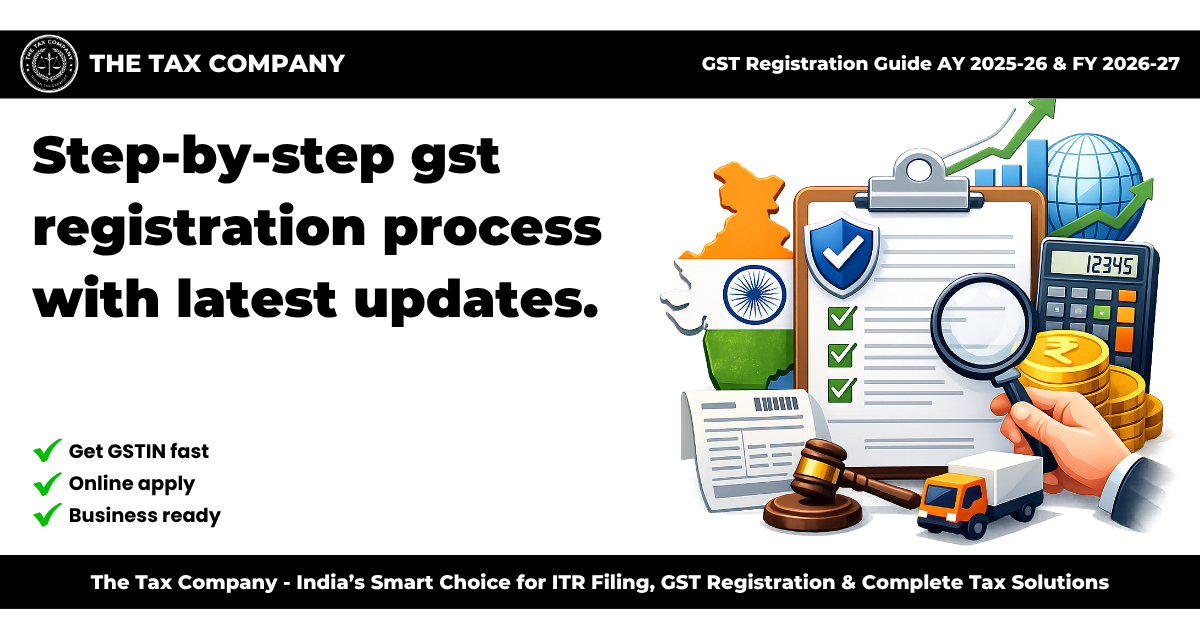
Goods and Services Tax (GST) is a unified indirect tax system applicable to the supply of goods and services across India. GST registration is mandatory for businesses that meet certain turnover thresholds or engage in specific activities.
For Assessment Year (AY) 2025-26 and Financial Year (FY) 2026-27, businesses must understand GST registration requirements to ensure compliance and avoid penalties.
This guide provides a complete overview of GST registration.
What is GST Registration?
GST registration is the process by which a business gets registered under the Goods and Services Tax law and receives a unique Goods and Services Tax Identification Number (GSTIN).
It allows businesses to collect tax from customers and claim input tax credit.
Who is Required to Register under GST?
GST registration is mandatory for:
- Businesses with turnover exceeding prescribed limits (generally Rs. 40 lakh for goods and Rs. 20 lakh for services, subject to state variations)
- Interstate suppliers of goods or services
- E-commerce sellers and operators
- Casual taxable persons
- Non-resident taxable persons
Voluntary GST Registration
Businesses below the threshold can also opt for voluntary registration to:
- Claim input tax credit
- Enhance business credibility
- Expand operations across states
Benefits of GST Registration
- Legal recognition as a supplier
- Ability to collect GST
- Eligibility for input tax credit
- Expansion of business opportunities
- Improved compliance and transparency
Documents Required for GST Registration
The following documents are generally required:
- PAN card of business or applicant
- Aadhaar card
- Business registration certificate
- Address proof of business premises
- Bank account details
- Photograph of applicant
- Digital signature (for companies and LLPs)
Step-by-Step GST Registration Process
Step 1: Visit GST Portal
- Access the official GST website
Step 2: Fill Part A of Application
- Enter PAN, mobile number, and email ID
Step 3: Verify OTP
- Complete OTP verification
Step 4: Fill Part B of Application
- Provide business details, address, and bank information
Step 5: Upload Documents
- Submit required documents
Step 6: Submit Application
- Complete application using DSC, EVC, or Aadhaar authentication
Step 7: GSTIN Allotment
- GSTIN is issued after approval
Processing Time
- Generally 3 to 7 working days
- May vary depending on verification
GST Registration Fees
- No government fee for GST registration
- Professional charges may apply if assistance is taken
Post-Registration Compliance
After registration, businesses must:
- File GST returns regularly
- Maintain proper records
- Issue GST-compliant invoices
- Pay taxes within due dates
Penalty for Non-Registration
Failure to register may result in:
- Penalty equal to tax amount or Rs. 10,000 (whichever is higher)
- Legal consequences
- Business restrictions
Common Mistakes to Avoid
- Providing incorrect business details
- Uploading incomplete documents
- Selecting wrong business category
- Not verifying application properly
Tips for Smooth GST Registration
- Ensure accurate and consistent information
- Keep all documents ready
- Verify PAN and Aadhaar details
- Use correct contact information
Role of Professional Assistance
Professional assistance can help:
- Ensure correct registration
- Avoid errors and delays
- Handle documentation
- Provide compliance support
Conclusion
GST registration is a critical step for businesses to operate legally and efficiently under India’s tax system. Proper registration ensures compliance and enables businesses to benefit from input tax credit and market expansion.
For AY 2025-26 and FY 2026-27, businesses should complete GST registration timely and maintain ongoing compliance.
Need Help with GST Registration?
The Tax Company (TTC) provides expert assistance in GST registration and compliance. Our team ensures smooth processing and accurate documentation.
Contact us today for professional support.